domingo, 23 de junio de 2013

Los jardines del presidente,novela de Muhsin Al-Ramli

LOS JARDINES DEL PRESIDENTE
Nueva novela del escritor iraquí Muhsin Al-Ramli
Abdllah Taouti
     La poesía ha sido el género más cultivado por los autores de  la literatura árabe. Hace poco tiempo que se escribe y lee más novela. Gracias a ello nuevos nombres han brillado en la narrativa árabe, entre ellos el iraquí Muhsin Al-Ramli, quien escribe en árabe y castellano. Autor que ha sido descrito, por el Cultural del diario español El mundo como uno de los más importantes novelistas y dramaturgos iraquíes traductor de varios clásicos españoles al árabe.
El autor de la novela Dedos de Dátiles mostró un talento muy especial para la escritura y pudo  enriquecer la biblioteca árabe con una docena de libros interesantes, entre ellos su última novela Los jardines del  presidente, publicada conjuntamente por las editoriales Thaqafa en Abu Dhabi y al-Arabiya lil-Ulum en Beirut. Publicación  finalista del premio Internacional de la Narrativa Árabe (Booker) en su sexta edición 2013. La novela repasa los últimos cincuenta  años de la historia de Iraq a través del relato de la vida de tres amigos: Abdallah Kafka, Tarek Al-Mondahich (Tarek el asombrado) y Ibrahim Kisma (Ibrahim suerte). La novela está fundamentada en la idea de que cada persona es un mundo y tiene su vida propia y. por ende, su historia, sus amores y desamores, sus sueños y particularidades… así que  el autor  no deja de mostrar su asombro a la prensa que no cesa de presentar a las víctimas como meros números de guerra. 
     Se trata de una novela que permite al lector la comprensión de la complejidad de la situación actual en Iraq y de la historia iraquí, con dominio del estilo y eficacia en la narración, dividida en 28 capítulos que proporcionan fechas, temas y sucesos. La vida de los protagonistas se yuxtapone con un bagaje histórico que añade experiencias y conocimiento acerca de las guerras en Irán y Kuwait: el embargo, la dictadura, las fosas comunes, la invasión americana y el enfrentamiento interno. Es la historia de Iraq a través de la vida de gente sencilla que sufrió, desde mediados del siglo pasado hasta el año 2006, bajo la ocupación americana que destruyó el país y fundó el caos en esa tierra que sigue sangrando hasta hoy en día.
    La novela de Muhsin Al-Ramli se convirtió, igual que las dos anteriores, en un éxito narrativo en el mundo árabe. Su novel Añicos esparcidos, publicada en El Cairo y traducida al inglés bajo el título (Scattered Crumbs), ganó en 2002 el premio Arabic Translation Award de la Universidad de Arkansas, y Dedos de dátiles que fue publicada primero en castellano (Madrid 2008) ha sido finalista del premio internacional Booker de la novela árabe 2010. Son muchos los artículos escritos sobre la tercera novela de este autor Los jardines del presidente; los críticos no cesan de  evaluar el trabajo bien hecho de Al-Ramli. La conocida escritora egipcia Miral Al-Tahawi sitúa, en una rueda de prensa,  a Los Jardines del presidente como la mejor obra editada últimamente  junto con  la Tierra de Sudán del escritor sudanés Amir Tay Assir, Asimismo,  el gran crítico árabe Salah Fadl, en un artículo publicado en El Misri Al-Yawm, señala que le  asombra la nueva novela del escritor iraquí  Muhsin Al-Ramli añadiendo que no puede imaginar como el autor ha  podido, desde su exilio, escribir la historia de su país de un manera tan precisa y detallada, además con  técnicas narrativas firmes y un estilo más cercano a la poesía  que nos regala, al final,  con un excelente texto creativo.
Muhsin Al-Ramli, nació en el norte de Iraq en 1967. Contrario al régimen de Saddam Hussein (que ha perseguido a su familia y condenado a muerte a su hermano, el poeta y escritor Hassan Mutlak, en 1990) ha elegido el camino del exilio desde 1993 y vive en Madrid desde 1995. Doctorado en Filosofía y Letras por la Universidad Autónoma de Madrid en 2003, presentó una tesis sobre “Las huellas de la cultura islámica en el Quijote”. Escritor, poeta, traductor y académico. En España, fundó y codirigió la revista literaria en lengua árabe Alwah.  Algunos textos suyos han sido traducidos a varias lenguas y su última novela Los jardines del presidente ya está en proceso de traducción al castellano.
Finalmente, cabe mencionar que, del 27 de noviembre al 7 de diciembre del 2011, Muhsin Al-Ramli visitó México en el marco del 25 Aniversario de La Feria Internacional del Libro (FIL) de Guadalajara donde dictó una conferencia y participó de diversos actos culturales; entre ellos la conferencia ¨Cultura Iraquí, poesía y literatura” en la Preparatoria Regional de San Juan de los Lagos. En la Universidad del Claustro de Sor Juana  presentó una charla acerca de su obra y la cultura árabe. Y en la Casa Refugio Citlaltépetl, ciudad de México, presentó sus poemarios: Todos somos viudos de las respuestas y Dormida entre soldados.
-------------------------------------------------
*Publicado en la revista mexicana (Delatripa) Nº.4, 2013 págs. 71 y 72
*Abdllah Taouti, Escritor y traductor marroquí. 

miércoles, 3 de abril de 2013

Short story by Muhsin Al-Ramli


 Fiction by Muhsin Al-Ramli
This is how our village acquired its own Rambo and Tarzan.
Translated by Yasmeen Hanoosh
Just as the thirteenth year of my life started, the Iraqi-Iran war began. Before it was even a year old, my oldest brother was killed and one of my cousins was taken as a prisoner of war. That is when I began hearing my father curse “Mr. President” whenever he found himself alone with my mother in the orchard, kitchen, or bedroom, or as she milked our cows in the pen. I was irremediably confused as I sat torn between these obscene curses and those beautiful pictures and songs they taught us in school, praising the president, the great teacher, the hero, the valiant, the genius, the powerful, the necessity, the inspired, etc.—among other names and attributes in a long list of big words. We did not understand all of them at the time, yet we began dreaming of seeing him even if only in our dreams. There were those among us who claimed that this wish had come true for them…………


domingo, 10 de marzo de 2013

el escritor iraquí Muhsin Al-Ramli /Andrea Cascianelli

EL ESCRITOR IRAQUÍ MUHSIN AL-RAMLI
Por: Andrea Cascianelli
                      - Italia -
 
Hoy, en la Península Ibérica encontramos a muchos escritores que vienen de Países Árabes y que escriben tanto en su propia lengua cuanto en la lengua de llegada, y Muhsin Al-Ramli es uno de esos.
 “Salí por España porque tenía miedo, porque no podía encontrar trabajo y por fin soñaba la libertad”
Con esta frase, se puede entender que este autor iraquí escapó de su País amado para llegar a España y así encontrar la libertad.
Tuve la oportunidad de conocerlo a una conferencia que se celebró en Madrid y me gustó muchísimo. La cosa que más me sorprendió fue su fuerza. Este escritor no obstante las dificultades económicas de los primeros años en Europa, llegó a ser profesor y escritor.
Muhsin Al-Ramli nunca puede olvidar lo que su País ha sufrido en los últimos años. Esto se puede averiguar considerando todos los temas más significativos de sus obras:
1. LA NOSTALGIA POR SU PATRIA Y SU FAMILIA
 2.LA GUERRA
 3.EL AMOR POR CADA FORMA DE ARTE
 4.LA ACOGIDA EN ESPAÑA
 Su última obra حدائق الرئيس, que en español se podría traducir “los jardines del Presidente”, todavía no ha sido traducida a ningún idioma
--------------------------------------------------------------------
*Publicado en: andreaca2008
 **foto: Muhsin Al-Ramli, fotografiado por: Yahya Al-Batat

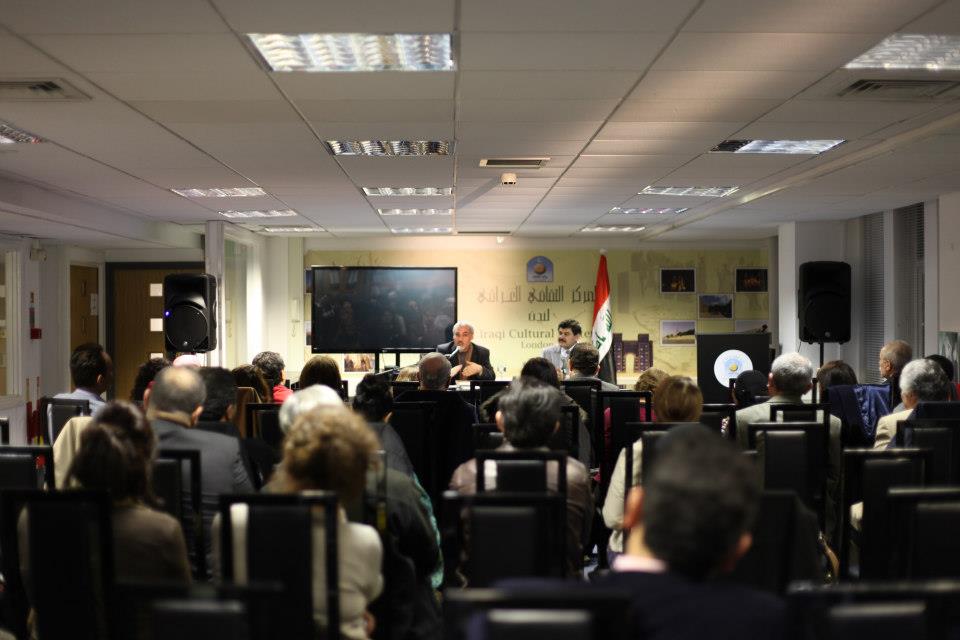
Muhsin Al-Ramli en Londres


Muhsin Al-Ramli, dio dos conferencias en Londres, sobre:
su novela (Los jardines del presidente) y (La influencias de la cultura árabe-islámica en el Quijote) en los días 8 y 9 de febrero 2013.


Video, parte de la conferencia (en árabe).
 
 
******************************


en la prensa


viernes, 11 de enero de 2013

DOS AUTORES IRAQUÍES / Álvaro Abella

LAS SIMILITUDES DE DOS AUTORES IRAQUÍES
 
Álvaro Abella
Si hay un país árabe que lleva años sufriendo el dolor y los traumas de la guerra, ese es Iraq. La sinrazón de tres décadas de conflictos armados, bloqueos, invasiones y destrucción ha dejado su huella en la literatura de un país que fue la cuna de la civilización mundial. Ya que estamos repasando la lista de novelas que optarán al Premio Internacional de Narrativa Árabe 2013, vamos a fijarnos hoy en los dos autores iraquíes que figuran en la lista: Sinan Antoon y Muhsin Al-Ramli.
Al repasar las biografías de los dos autores, sorprende descubrir que comparten varios puntos en común. Ambos son de la misma quinta (nacidos en 1967) y forman parte de la diáspora iraquí (Sinan Antoon reside en Nueva York desde los años noventa, mientras que Muhsin Al-Ramli lleva años afincado entre nosotros, en Madrid). Ambos combinan el cultivo de la narrativa con el de la poesía. Y, por si fuera poco, los dos son reconocidos traductores. Antoon ha traducido al inglés a grandes poetas como Mahmoud Darwish y Saadi Youssef, mientras que Al-Ramli ha vertido al árabe a clásicos españoles como Cervantes o Lope de Vega.
Los dos autores optan a la sexta edición del IPAF con dos novelas que reflejan el drama y el caos de la existencia cotidiana en Iraq. Sinan Antoon presenta Ave María  ( يا مريم ), publicada por Al-Jamal, editorial germano-libanesa con sede en Beirut. La novela transcurre durante un solo día y muestra dos visiones opuestas de la vida, encarnadas por dos miembros de una familia  iraquí cristiana a los que la situación del país termina reuniendo en Bagdad bajo un mismo techo. Youssef es un anciano solitario que se niega a emirar y abandonar la casa que levantó y en la que lleva viviendo medio siglo. Se aferra a la esperanza y a los recuerdos de un pasado feliz. Maha es una joven cuya vida se ve desgarrada por la violencia sectaria. Su familia ha perdido su hogar y se ha convertido en refugiada en su propio país, buscando asilo en la casa de Youssef. Junto a su marido, espera la posibilidad de emigrar y abandonar un país que siente que no la quiere. La esperanza se choca con el destino cuando sucede un evento que cambiará la vida de los dos personajes para siempre. La novela plantea cuestiones difíciles y ásperas sobre la situación de las minorías en Iraq.
Por su parte, Muhsin Al-Ramli ha sido seleccionado por Los jardines del presidente ( حدائق الرئيس ), publicada conjuntamente por las editoriales Thaqafa en Abu Dhabi y al-Arabiya lil-Ulum Nashirun en Beirut. La obra repasa los últimos cincuenta años de la historia de Iraq a través del relato de la vida de tres amigos. El autor explora el efecto que tuvieron las guerras, el bloqueo o la invasión de Kuwait en la existencia de personas corrientes. Al-Ramli analiza también la separación existente entre quienes ostentan el poder y los ciudadanos de a pie. Durante el caos de la ocupación, uno de los personajes pierde la vida, al igual que muchos iraquíes que se vieron atrapados entre el fuego cruzado de los leales al antiguo régimen de Sadam y los partidarios del nuevo orden. La novela ayuda al lector a comprender las complejidades de las sucesivas tragedias que han asolado Iraq. Se trata de una historia desgarradora pero narrada con humanidad, en la que la vida termina venciendo a pesar de todos los obstáculos. En la revista electrónica ILA encontramos una reseña de la novela en castellano.
----------------------------------------------------------
*Publicado en el blog del arabista y traductor español  Álvaro Abella, (La atalaya del traductor) en 3 de enero de 2013
 

jueves, 3 de enero de 2013

Interview with Muhsin Al-Ramli, Author of The President's Gardens

Longlisted author interviews
 
An interview with Muhsin Al-Ramli
2 January 2013
*When did you begin writing The President's Gardens and where did the inspiration for it come from?
- I began writing it in 2006 after receiving the news of the murder of nine of my relatives, who were fasting on the third day of Ramadan. The people of the village found only their heads in boxes of bananas, with their identity cards. So I dedicated the novel to their souls. That was a huge shock to me. It horrified me and made me weep and to start with, writing the novel was a reaction [to this event] undertaken without planning or a clear vision. So I put it aside in the hope of achieving an old ambition, that of writing a novel encompassing what ordinary people have suffered through the violent tragedies of Iraq in its modern history, a novel like The Bridge on the Drina by the Yugoslav novelist Ivo Andric, which relates the history of his country over generations and in which the bridge is the focal point unifying the different events and periods of the book. Another motivation for writing is that when I have taken part in cultural activities and events in many countries, I have seen the difficulty people have in understanding the complexity of the Iraqi situation and I have felt extremely sad and angry when the world press reports Iraqi victims as though they were merely numbers, so I went and gathered information systematically. I travelled to Syria to meet my brother and his son there to ask them for more details. I did not go back and begin writing again until the end of 2008, after reading an old, short piece of news about someone who used to work burying anonymous executed people in Iraq and who secretly kept something belonging to them, whether it was a card, bill, watch or ring. He would record some of their personal characteristics and information about where they were buried. After the fall of the regime, he helped many families to find the remains of corpses of their lost ones.
 *Did the novel take long to write and where were you when you completed it?
- Yes, about four years, but that was not continuous writing. I would write and then stop to write other things, then return to the novel, search for more information and go back to it, asking advice from friends, and so on. It was written in four places: I began in Madrid and carried on in Granada and Iraq where I went for a short time and did more research. I finished the first draft in Asturias in northern Spain. After that, I did various revisions in Madrid, so it was begun and finished there, where I live.
*How have readers and critics received the novel?
- The novel has been received far better than I expected. The critical views expressed reassured me that it was technically solid. Readers' views, which are the most important, made me feel that this novel had conveyed the message I intended. I received calls and letters from readers who follow my writings, who said that 'this is the novel we have been waiting for you to write'. Others said: 'We now understand what was going on in Iraq and the reasons for what is happening now'. Some confessed that their view had completely changed, after they had previously been sympathetic towards the ousted dictator of Iraq and supported him against his enemies. Some on social networks wrote about their hope that rulers and ruled would read it so that the whirlpool of violence in this Arab world of ours would become calmer, after we experience something of humanity. Amongst other calls, there was someone from Iraq thanking me because I had managed to express their pain.
*Do you have a literary project planned for the future?
- To write a new novel, of course. I have started preparing for it now. I would like it to be about love this time and to be different in language, style and technique from The President's Gardens, since the subject is different, although Iraqi pain will also be present in some form. But I want it to be a deep exploration of love and beauty within this destruction.
-----------------------------------
*Published in (The International Prize for Arabic Fiction (IPAF)), 2 January 2013.
-------------------------------------------------
Novel: The President's Gardens: Set during the last fifty years of Iraqi history, this novel tells the story of three friends, exploring how ordinary people have been affected by historic events such as wars, the blockade of Iraq and the invasion of Kuwait. It examines the gap between the lifestyle of those in power and ordinary citizens. During the chaos of occupation, one of them loses his life, like so many caught between loyalists of the old and new regimes. The President's Gardens helps the reader understand the complexities of the successive tragedies besetting the ‘land between two rivers’. The gripping story is told with humanity, and life is somehow the victor despite all the obstacles.
Author: Muhsin Al-Ramli, is an Iraqi academic and translator, born in the village of Sudera in northern Iraq in 1967. He has lived in Madrid since 1995 and received his doctorate in literature and philosophy there from Madrid University. He writes in both Arabic and Spanish and published his first work in 1983. Over the years he has worked as a writer, correspondent and cultural editor and has translated a number of Spanish literary works into Arabic (including Cervantes), as well as translating Arabic works into Spanish. He is the founder, publisher and co-publisher of the cultural review Alwah (the only Arabic cultural magazine in Spain) and currently works at Saint Louis University, the American university in Madrid.

martes, 1 de enero de 2013

Authors’ Favorites of 2012:Fiction, M. Al-Ramli

Authors’ Favorites of 2012: Arabic fiction
About authors’ Favorites of 2012: Fiction, and finally, acclaimed Arab writers’ favorite novels of 2012. Some can be found on the “Arabic Booker” longlist.
About Muhsin Al-Ramli
*Ali Bader,( Iraqi novelist) :
“I have recently finished reading three ambitious Iraqi novels, The President’s Gardens (2012) by Muhsin Al-Ramli.
The President’s Gardens is a novel about three friends living in northern Iraqi village. Al-Ramli’s novel has strong political themes drawn from Iraqi social history, and gives a hard critical examination of the power held by the Saddam Hussein regime, and after, during the epoch of American occupation: the civil strife, unlawful killing, torture and ill treatment, kidnapping and hostages. It sheds some specific reflection, albeit in fictional guise, on the nature of the authoritism, and also analyzes the economics, politics, and rule of the régime as a history book might.”
*Hassan Blasim, (Iraqi short-story writer) :
“I would choose the novel by Muhsin Al-Ramli Fingers of Dates (2008).This novel is free from the exaggerated poetic language sometimes found in Arab narratives. And it’s an Iraqi novel that doesn’t use the language of melancholy and melodrama, as happens in Iraqi novels. It’s a clever novel — it explores with a sense of fun the depths of tragicomedy in Iraq during the dictatorship.”
*Ahmad Yamani, (Egyptian poet) :
“Al-Ramli now (with The President’s Gardens) returns with this new novel on war and dictatorship in Iraq. In spite of the brutality, in certain scenes, and the naked language, this novel presents Iraq’s pain in beautiful art.”